Every Autistic Child Deserves the Best Autism School in Delhi
There is a moment every parent of an autistic child remembers.
It is not always the diagnosis. Sometimes it comes earlier, in a paediatrician's waiting room, or during a parent-teacher meeting where the words used to describe your child feel clinical and cold. Sometimes it comes later, after months of watching your child struggle in a classroom that was never designed with them in mind.
Whatever that moment was for you, it carried a question underneath it. A question you may not have said out loud but felt with every part of you.
Will my child be okay?
The answer is yes. But it depends enormously on the environment you place them in. It depends on the school, the approach, the team, and the belief system of the people working with your child every single day.
Every autistic child deserves the best autism school in Delhi. Not a school that tolerates them. Not a school that manages them. A school that genuinely sees them, understands them, and builds a future around their strengths.
This blog is about what that school looks like, why it matters more than most parents realise, and how to find it.
The Problem With One Size Fits All Education
The mainstream education system was built for a specific kind of learner.
A learner who can sit still for forty minutes. Who processes verbal instructions quickly. Who transitions between subjects without distress. Who can filter out the noise of thirty other children and focus on a blackboard. Who understands unspoken social rules without being taught them explicitly.
For many autistic children, every single one of these assumptions is a barrier.
This is not a failure of the child. It is a failure of the environment.
When an autistic child is placed in a classroom that does not account for their sensory needs, their communication style, or their learning pace, they do not simply fall behind academically. They begin to associate learning with anxiety. They begin to see themselves as the problem. And they carry that belief far longer than any academic gap.
The best autism school in Delhi does not ask an autistic child to fit a system. It builds a system around the child.
What Makes a School Truly Right for an Autistic Child
Not every school that calls itself a special school is equipped to genuinely serve autistic children. And not every school that claims to be inclusive has done the work that inclusion actually requires.
Here is what separates a school that is right for an autistic child from one that simply accepts them:
Individualised Education Plans
Every autistic child learns differently. A school that uses the same programme for every child regardless of their profile, their strengths, their challenges, and their goals is not truly serving those children. The best autism school in Delhi builds a unique education plan for each child, reviews it regularly, and adjusts it as the child grows.
A Multidisciplinary Team Under One Roof
Autism does not exist in isolation. Most autistic children also have co-occurring challenges in speech and communication, sensory processing, behaviour, fine motor skills, or emotional regulation. A school that only offers academic instruction without addressing these dimensions is leaving enormous developmental potential on the table.
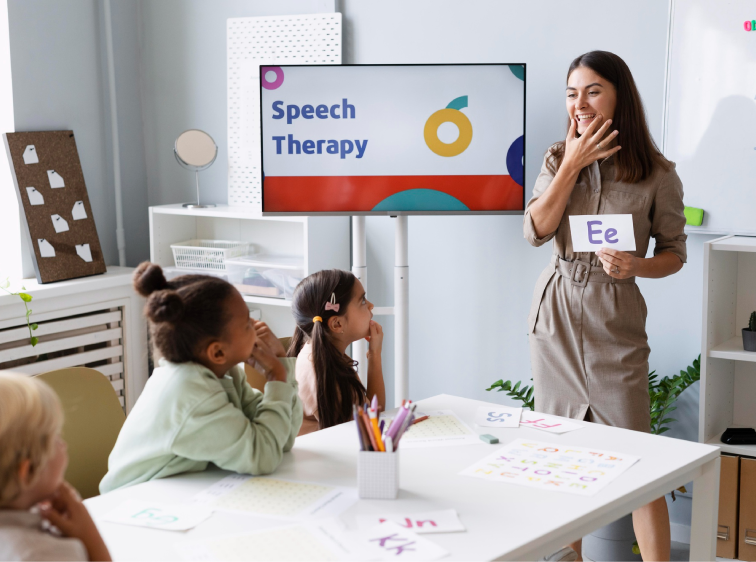
The best autism school in Delhi brings together special educators, speech therapists, occupational therapists, ABA specialists, behaviour modification experts, and counselling psychologists. Not as separate services the family has to coordinate themselves, but as an integrated team working from a single coordinated plan.
Sensory-Aware Environments
The physical environment of a school matters profoundly for autistic children. Fluorescent lighting, echoing corridors, unpredictable noise, and visually cluttered classrooms can push a child's nervous system into a state of overwhelm before the school day has even properly begun.
A school that understands autism designs its environment with sensory needs in mind. Quieter spaces. Predictable routines. Visual schedules. Sensory breaks built into the day.
Communication-First Approach
For non-verbal or minimally verbal autistic children, communication is not a side issue. It is the central challenge around which everything else is organised. The best autism school in Delhi prioritises communication above almost everything else, using a range of tools and approaches including verbal behaviour strategies, augmentative and alternative communication, picture exchange systems, and social communication programmes.
Genuine Belief in Every Child's Potential
This one is harder to measure but easier to feel.
Walk into a school and watch how the staff speak about the children. Watch how they respond when a child has a difficult moment. Watch whether they see a problem to manage or a person to understand.
The best autism school in Delhi is built on a foundational belief that every autistic child, regardless of where they are today, has the capacity to grow, to learn, to connect, and to build a life of meaning and independence.
The Real Cost of the Wrong School
Parents sometimes choose a school based on proximity, cost, or availability. These are understandable factors. But the cost of the wrong school is rarely visible until it has already been paid.
A child who spends two or three years in an environment that does not understand them does not just miss academic content. They miss the developmental windows that exist in early childhood. They build anxiety and avoidance around learning. They may develop challenging behaviours that are actually communication, a signal that their needs are not being met.
Reversing these outcomes is possible. But it takes significantly more time and more intensive support than it would have if the right environment had been found earlier.
This is not written to create guilt in parents who made the best decisions they could with the information they had. It is written because the information matters. Because the school you choose for your autistic child is one of the most consequential decisions you will make in their early years.
A Portrait of Progress: What the Right School Makes Possible
Consider what a structured, supportive, individualised school environment actually builds over time.
A non-verbal child who arrives at four years old using no functional communication begins learning to point, then to use picture cards, then to use a communication device. By age seven they are making requests, expressing preferences, and initiating interactions with familiar adults.
A child who arrived overwhelmed by every transition, who could not sit in a group for more than two minutes, who needed one-to-one support for every activity, gradually builds the regulation skills and the trust that allows them to participate in small group learning. By age nine they are following a structured daily routine independently and beginning to develop friendships.
A teenager who has been in the right school since early childhood is now learning vocational skills. They can manage money, follow a schedule, communicate their needs, and think about a future that is genuinely their own.
These are not exceptional stories. They are outcomes that happen consistently when autistic children receive the right support in the right environment at the right time.
The best autism school in Delhi is not chasing a cure. It is building a life.
Why AILC Has Been That School for Over Thirty Years
Adhyayan Inclusive Learning Centre has been working with autistic children and their families in Delhi for more than three decades.
In that time, the understanding of autism has evolved significantly. The approaches, the tools, and the research have all moved forward. AILC has moved with them. The centre continues to update its methods, train its staff, and refine its programmes to reflect the best current evidence on what helps autistic children thrive.
What has not changed is the core belief that brought AILC into existence in the first place.
Every child, regardless of their diagnosis, their communication level, their behaviour profile, or their family background, deserves to be seen as a whole person with unlimited potential.
At AILC, every autistic child receives a comprehensive assessment before their programme begins. This assessment looks at communication, cognition, sensory processing, motor skills, behaviour, social development, and daily living skills. From this assessment, an individualised education and therapy plan is built that addresses every dimension of the child's development.
The team at AILC includes special educators, speech therapists, occupational therapists, ABA specialists, behaviour modification therapists, counselling psychologists, and career counsellors for older students. These professionals do not work in silos. They meet regularly, share observations, and adjust their individual approaches to ensure that every child's programme is coherent, coordinated, and moving in the same direction.
Parents are partners at AILC, not observers. Regular reviews, parent training sessions, and open communication channels ensure that what happens in school is reinforced at home, and that the family's knowledge of their child enriches the programme.
For older students between the ages of nine and eighteen, AILC offers vocational training programmes that build real-world skills and create pathways toward meaningful independence and employment.
Over two thousand families in Delhi and surrounding areas including Faridabad have trusted AILC with their children. The centre is located in South Extension Part 1, New Delhi, accessible to families across South Delhi, Central Delhi, and the wider NCR region.
How to Know If Your Child Is in the Right Place
Sometimes parents sense that something is not working before they can articulate exactly what it is.
Their child is not progressing the way they expected. Their child is increasingly anxious about going to school. The reports from the school feel generic, as though they could have been written about any child. The therapies feel disconnected from each other.
If any of this is familiar, it may be time to explore whether a different environment would serve your child better.
Ask these questions of any school you are considering:
- How do you build an individualised plan for my child specifically?
- How do your therapists and educators communicate with each other about my child's progress?
- How do you involve parents in the programme?
- How do you support a child who is non-verbal or minimally verbal?
- What does your approach look like for a child who struggles with sensory processing?
- What are the long-term outcomes you are working toward for my child?
The answers will tell you a great deal about whether the school truly understands autism or simply manages it.
Your Child Is Not Waiting for the Perfect Moment. Neither Should You.
Every month that passes is a month of neural development. A month of social learning. A month of building or missing the foundational skills that everything else is built on.
The best autism school in Delhi is not a distant ideal. It exists. It is accessible. And it is ready to meet your child exactly where they are today.
If you are in Delhi or the surrounding NCR region and you are looking for a school that will not just accommodate your autistic child but genuinely invest in them, contact AILC.
Book a visit. Meet the team. Bring your questions. Come with your child's story.
Because your child deserves a school that is ready to hear it.